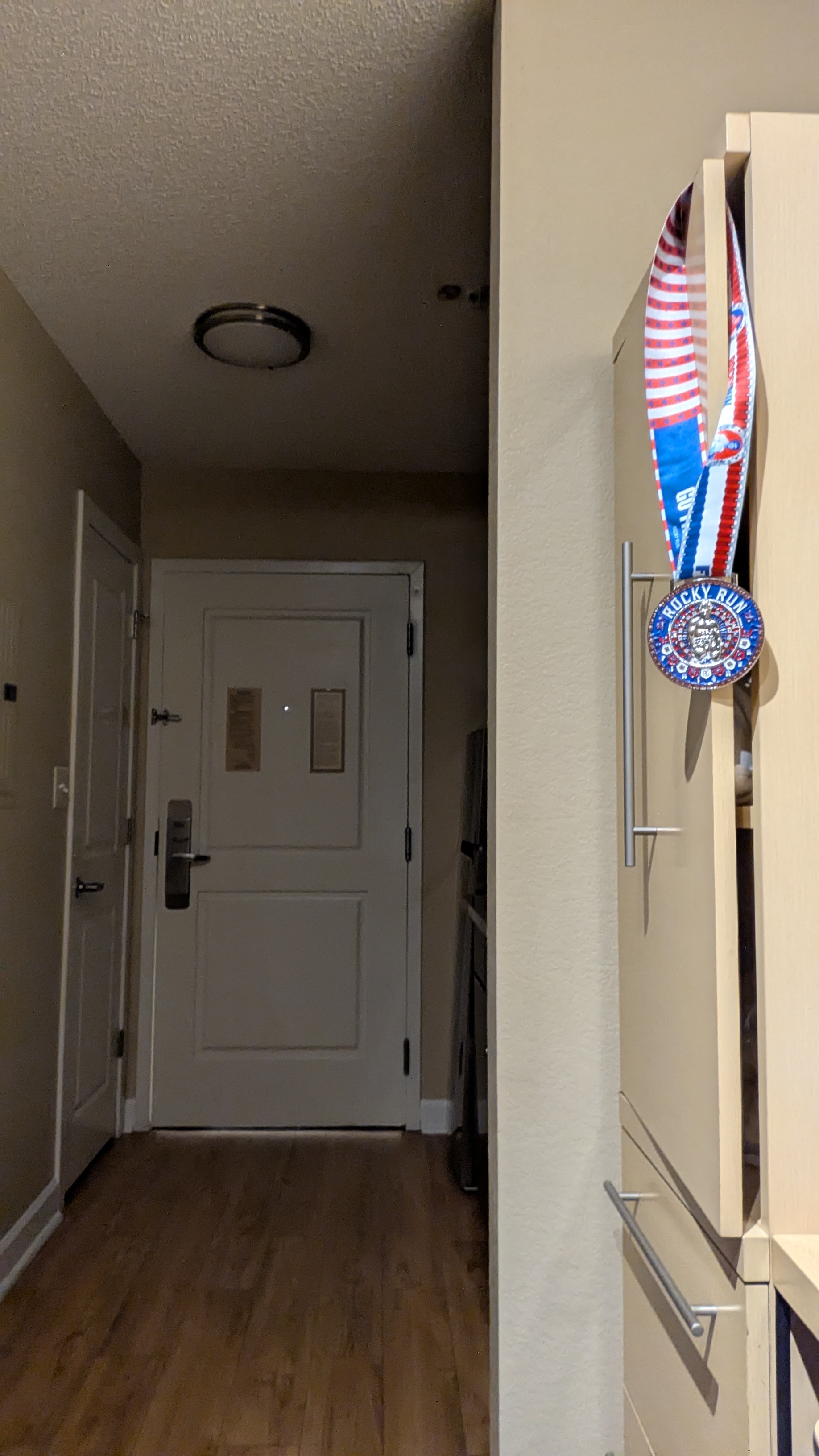
viewof course I'm blogging this it's fuego. If I get a zero I'll feel like an asshole but what else is new-I still stand by it.
Voice I’m Becoming
I wrote this in reverse order of the writing prompt as when I got to the end initially it changed my thoughts on the beginning. Which is I believe the sort of richness Weick discusses…the process of writing changed my perspective on what I was writing, and why. And most impactfully: for whom. ~ JR
My application essay for Drexel stated that I wanted this degree to serve as the “period on the sentence” that is my career and my expertise. After fifteen months that is no longer my goal. This is not the end of one thing and the beginning of another so much as I would like this to be a Pivot into something else entirely.
What will you like to be known for through your dissertation?
I would like for my dissertation on habit formation and adherence – why we do the things we do and what makes them “stick” – to be a look at the sorts of aphorisms espoused in self-help books found in airports throughout the world. From James Covey “The Seven Habits of Highly Successful People” to James Clear “Atomic Habits” there is no shortage of experts with the Rosetta Stone to unlocking one’s personal transformation. My research grants me the opportunity to apply academic rigor and lived experience in a way that I hope will be impactful and most importantly, generalizable.
How will your research shape how you act, lead, or intervene in the world?
Carrying the banner of Drexel University student researcher into the world in pursuit of data for my dissertation has already shown me where the lines between disinterested observer and hands-on practitioner are drawn; to me it is a strength of the DBA program that I am able to do this as I am not sure a PhD with a purely academic CV would bring the sorts of depth in life experience to be able to draw the insights I have. Moving forward as Doctor Jason Rashaad in 2027 I recognize the opportunity to be that leader who has lived as well as studied and can speak with great confidence across realms. That is my voice and who I hope to become at the end of this process.
Interrogate your research questions again. What still feels unresolved, alive, or even a little messy in your study? What new questions and tensions keep showing up in your thoughts?
This was addressed during this most recent Residency and through iterative discussions with my chair, Dr. Mark Stehr, who was instrumental in identifying a key tension in my primary research question: Do behavioral nudges delivered through a mobile application function as commitment contracts for habit adherence? I was frankly tying myself into knots attempting to make this work because my prior understanding was that my research needed to align with existing research, more specifically the research of my chair or potential committee members, which is where my research questions came from in the first place. Freed from this self-imposed constraint I am now able to iterate on the core thrust of what I am actually attempting to observe: Do behavioral nudges affect habit adherence when personalized over time? This is still “messy” in that this is my first attempt to codify my thinking but let’s examine this “first draft” attempt:
Behavioral nudges – Post-it notes on the refrigerator, notifications on your phone, a text from a friend: Anything that can be considered a “nudge” to remind you of a habit behavior. “Don’t forget to pick the kids up from school.” “The dryer has completed a cycle.” “You are out of milk.” All of these are small “nudges” which link to a specific “ask” or habit behavior that the receiver must then complete.
Personalized – What makes the nudge specific to the receiver, informed by an understanding of their past habit behavior or other personal information. From using the person’s name (or other unique identifier) to referencing a personal detail, this is what should hold the viewer’s attention after the initial “alert” of the nudge.
Over time – The longitudinal aspect of behavioral nudging is at the core of what I hope to observe. This is the difference between getting an e-mail reminder from Duolingo to check in and complete a lesson and a friend sending you a text saying “hey I haven’t heard from you in a while and haven’t seen you around the gym; is everything okay?” My supposition is that the second — engaging with an individual where they are in order to guide their habits — is critical to the adherence of a new habit. We see this in coach-client, mentor-mentee, even advisory relationships regularly: These begin with laying groundwork to understand what an individual wants to accomplish, scaffolding a path forward based on that groundwork, and continuing on an iterative basis with “nudges” to maintain alignment toward goals. That is the basis of what I hope to observe and how I intend to compose the final version of my research memo.
Identify things that you have been assuming – about your topic, your data sources, or any other aspect relevant to your dissertation. For each one, ask: “What if this isn’t true?” What fresh angles ,tensions, or surprises appear if you loosen that belief? Choose one assumption that now feels worth challenging, and write about how that question could make your dissertation – or your practice – richer.
The core conceit of my topic is also its biggest weakness: its centrality to my personal lived experience. Fundamentally I am positing that because something worked for me it will work for others, and I am looking to my research to support this theory. If I am incorrect and behavioral nudging personalized over time has no effect whatsoever on habit adherence or worse, has a deleterious effect, I think there is still value in that discovery. My theory may fail validity checks following my experiment and not be generalizable but it will raise additional questions: Why do some habits stick and some don’t? Why was one individual able to alter their habits and maintain them over time if not through iterative behavioral nudging? A “failure to prove” in this case I believe would lead to the opportunity to go back to the data with those questions, perhaps archival data of habit behavior in an attempt to identify patterns. What makes an individual adhere to a goal beyond ninety days may be too broad for a doctoral dissertation, but there is opportunity there for a scholarly body of work were one so inclined.
What did you think you were studying at first – and what are you actually beginning to see now? Share one small moment or insight that shifted your understanding as you have gone through this session. Describe what this shift has taught you about how you are making sense of your dissertation research plan.
I started this process believing that trust as discussed in Dr. Gefen’s BUSN 910 was central to my observation, that it was the trust relationship between coach-client mentor-mentee etc that was core to habit adherence. Iterating on this concept from 910 and the “Kryptonates” exercise through our additional coursework quarter by quarter I began to see this as something that is not only challenging to observe but not necessarily valid within itself. Going back to the original exercise I ask: does broken trust between coach and client lead necessarily to the client breaking that habit, or does the client instead seek another, similar relationship to replace that previous trust relationship and continue habit behavior? Does broken trust lead to broken habits is another compelling research question that may not be answered within my doctoral dissertation, but certainly could within a larger scholarly body of work.
I believe what I have done here, writing in my voice – run on sentences , em dashes and all – is representative of the Voice I Am Becoming. Dr. Nag asked during our session “What is your voice? What is your perceived identity?” I think that someone who can speak effectively to the questions raised within this work has the Voice I would like to make my own.